


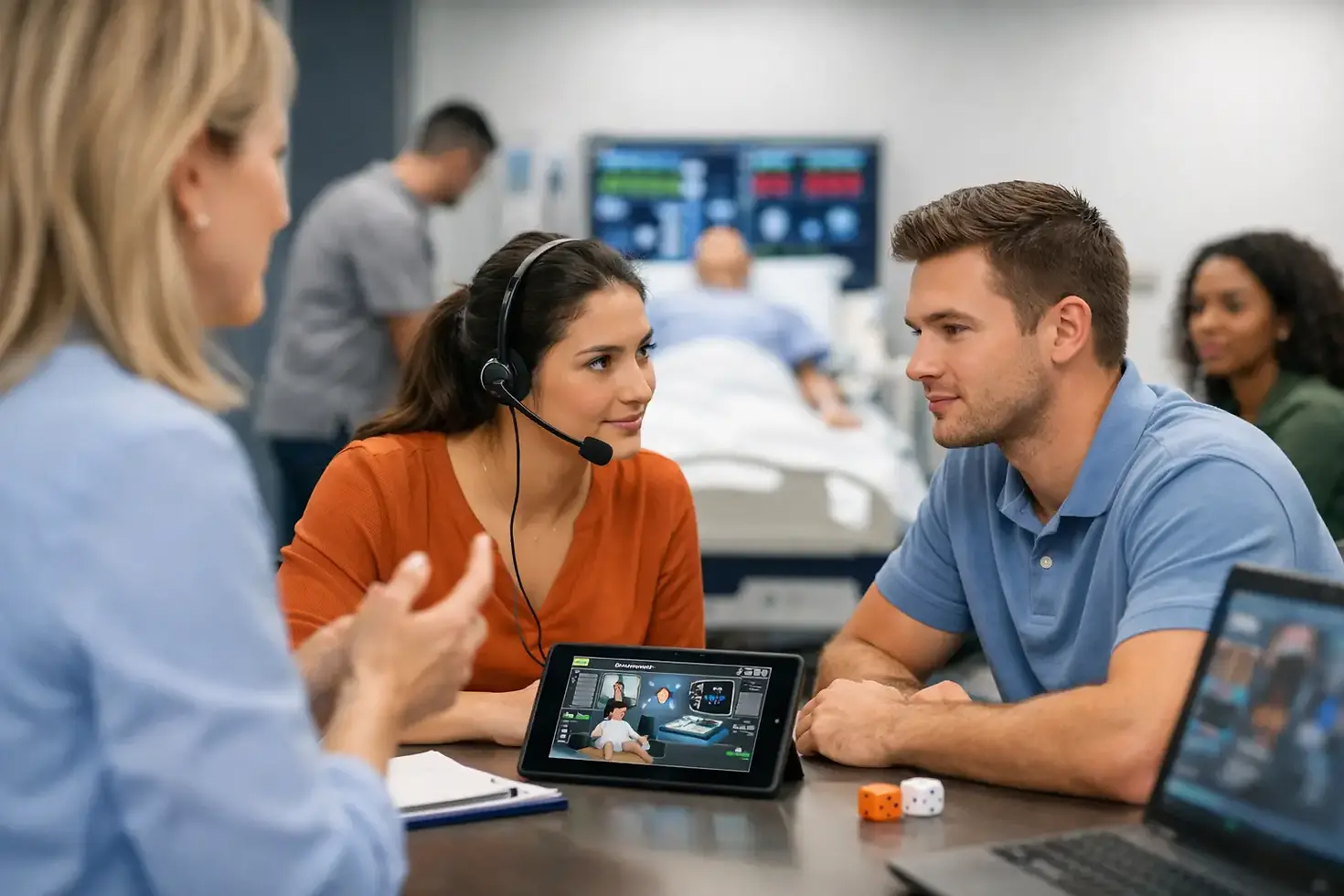
Simulation Facilitation Guide for Engaged Classrooms

A strong simulation facilitation guide begins before students make their first decision. The simulation may create energy, urgency, and meaningful choices, but the facilitator turns that activity into learning. For college students, that means helping them connect what happened in the room to how they will communicate, lead, collaborate, and respond to ethical pressure beyond campus.
The goal is not to explain every lesson for students. It is to create the conditions for them to notice patterns, test assumptions, hear perspectives unlike their own, and name what they would do differently next time. That is where a classroom game becomes an experience students remember and use.
Start With One Clear Learning Outcome
Before choosing a simulation or reviewing its instructions, decide what students should be able to practice. A leadership activity can support many outcomes, for example, but one class session cannot productively emphasize every one of them. Select a primary focus such as empathetic communication, ethical decision-making, team coordination, cultural awareness, or conflict management.
A focused outcome also makes facilitation easier. If students are managing a simulated project, you might ask them to pay close attention to how they allocate time and communicate priorities. If the experience centers on an ethical dilemma, direct their attention to the stakeholders affected by each option. Students need enough freedom to make authentic choices, along with a clear lens for interpreting those choices afterward.
Consider what evidence would show learning. It may be a more specific reflection, a student’s ability to explain the trade-off behind a decision, or a richer conversation among team members. This helps you assess more than whether a group “won” the activity.
Prepare the Room for Productive Participation
Facilitation starts with expectations. Students participate more fully when they understand that the simulation is a low-risk space to try, miss information, make imperfect choices, and learn from the consequences. Frame the activity as practice, not a test of who already has the strongest professional instincts.
Give students a concise purpose statement before they begin. For example: “As you work through this scenario, pay attention to the information you prioritize, the voices you seek out, and the consequences your team is willing to accept.” This is more useful than a lengthy lecture on the theory behind the activity. The experience should surface the need for that theory.
Practical setup matters, too. Confirm team sizes, timing, technology access, materials, and decision rules in advance. Assign roles when roles will help draw quieter students into the work, but avoid over-structuring every interaction. In some classes, rotating roles such as spokesperson, recorder, skeptic, or stakeholder advocate can strengthen accountability. In others, especially with experienced MBA learners, open team negotiation may reveal more natural leadership patterns.
The right level of structure depends on your students. First-year students often benefit from clearer time checks and role expectations. Graduate students may need more ambiguity so they can confront the complexity of real organizational decisions.
Introduce the Simulation Without Giving Away the Lesson
A common facilitation mistake is explaining too much before the activity begins. When instructors preview every likely takeaway, students can start searching for the “correct” answer instead of engaging with the scenario. Simulations work because decisions feel consequential, even when the stakes are classroom-based.
Explain the mechanics clearly, then protect the discovery process. Students should know what they are trying to accomplish, what constraints they face, how long they have, and how they will record or submit choices. They do not need a prediction of what will happen next.
Use a brief launch that creates focus: establish the scenario, clarify the decision task, and remind students that they will be expected to explain their reasoning. This last point changes the quality of participation. Teams are more likely to involve multiple perspectives when they know they must later discuss why they chose a particular path.
Facilitate During the Activity Without Taking Control
Once the simulation begins, resist the urge to solve problems for students. Your role shifts from presenter to observer, timekeeper, and strategic questioner. Circulate with purpose. Notice who is speaking, who is being overlooked, whether teams are working from evidence or assumptions, and where frustration may be revealing a valuable learning moment.
Ask questions that deepen thinking without steering students toward your preferred answer. Useful prompts include:
“What information is driving this choice?”
“Whose perspective is missing from this conversation?”
“What might this decision solve now, and what could it create later?”
“What is your team assuming about the other stakeholders?”
“If you had two more minutes, what would you want to know?”
These questions are especially effective when students rush toward consensus. Fast agreement is not always a sign of strong collaboration. It can signal that a team has avoided disagreement, deferred to the most confident voice, or treated a complex problem as simpler than it is.
At the same time, do not interrupt every struggle. Productive tension gives students a chance to practice self-awareness and communication under pressure. Step in when confusion is caused by unclear instructions, when a group is stuck on logistics rather than learning, or when participation dynamics prevent students from contributing. Otherwise, let teams own the decisions and the results.
Make the Debrief the Center of Learning
The debrief is where a simulation earns its instructional value. Without reflection, students may remember the excitement of the activity but miss the transferable skill behind it. Plan at least as much care for the discussion as you do for the gameplay.
A useful debrief moves from experience to interpretation to application. Start with concrete observations: What happened? What surprised you? Where did your team struggle? This gives every student an accessible entry point and prevents the conversation from becoming abstract too quickly.
Next, examine the decisions underneath the results. Ask why a team chose a path, what values guided that choice, and what competing priorities they had to manage. Invite teams that reached different outcomes to compare their reasoning. The goal is not to crown one group as the smartest. It is to show that professional decisions often involve legitimate trade-offs among speed, fairness, trust, outcomes, and available information.
Then move students toward transfer. Ask how a similar pattern could appear in a group project, internship, student organization, workplace meeting, or client interaction. A student who can say, “I noticed I stopped listening once I thought I understood the problem,” has gained something more useful than a score. They have identified a behavior they can change.
Questions That Produce Richer Discussion
Avoid ending with “What did you learn?” alone. It is well intentioned, but it often produces broad answers such as “teamwork is important.” Ask for specificity instead: “What did your team do that improved or weakened trust?” “What would you say differently in the next round?” “Which stakeholder experienced the consequences of your decision most directly?”
If discussion is quiet, give students one minute to write before they speak. Individual reflection helps students organize their thinking and allows those who process internally to contribute with more confidence. You can also ask students to discuss in pairs before bringing ideas to the full group.
Connect the Experience to Course Concepts
Students should leave the debrief able to connect the simulation to the language and frameworks of your course. This connection does not require a long lecture. A few well-timed concepts can help students make sense of what they experienced.
After a communication simulation, connect observations to active listening, feedback loops, or psychological safety. After an ethics scenario, examine stakeholder analysis, competing obligations, and the difference between legal compliance and responsible judgment. After a leadership exercise, discuss influence, decision authority, or the impact of emotional intelligence on group performance.
E.I. Games is designed around this bridge between active experience and practical reflection. When students first feel the impact of a choice, course concepts become tools for interpreting their own behavior rather than definitions to memorize.
Assess Learning Beyond the Final Outcome
Winning a simulation can reflect strong judgment, but it can also reflect luck, a favorable scenario, or a team that found an efficient tactic. Assessment should recognize the quality of students’ reasoning, reflection, and ability to apply learning.
A short post-simulation response works well. Ask students to identify one decision their team made, explain the factors they considered, describe a perspective they initially missed, and state one action they would carry into a future academic or professional setting. This format makes reflection concrete and gives instructors useful evidence of growth.
For recurring simulations or larger programs, look for patterns across responses. Are students becoming more precise about stakeholder impact? Are they naming communication behaviors rather than using vague language? Are quieter students participating more consistently? These indicators can reveal progress in the professional skills that are often difficult to teach through lecture alone.
Improve the Next Facilitation
After class, take five minutes to record what happened. Note where students needed more instruction, which question opened the strongest discussion, where timing felt rushed, and which teams needed additional support. Small adjustments can significantly improve the next run.
Do not judge an activity only by volume or visible excitement. A lively room can still produce shallow reflection, while a thoughtful, quieter group may be doing serious intellectual work. The strongest facilitation balances engagement with enough pause for students to make meaning from the experience.
When students are trusted to make decisions, examine consequences, and reflect honestly, simulations become more than a break from lecture. They become a rehearsal space for the judgment, empathy, and communication students will need when the choices are real.


Comments